


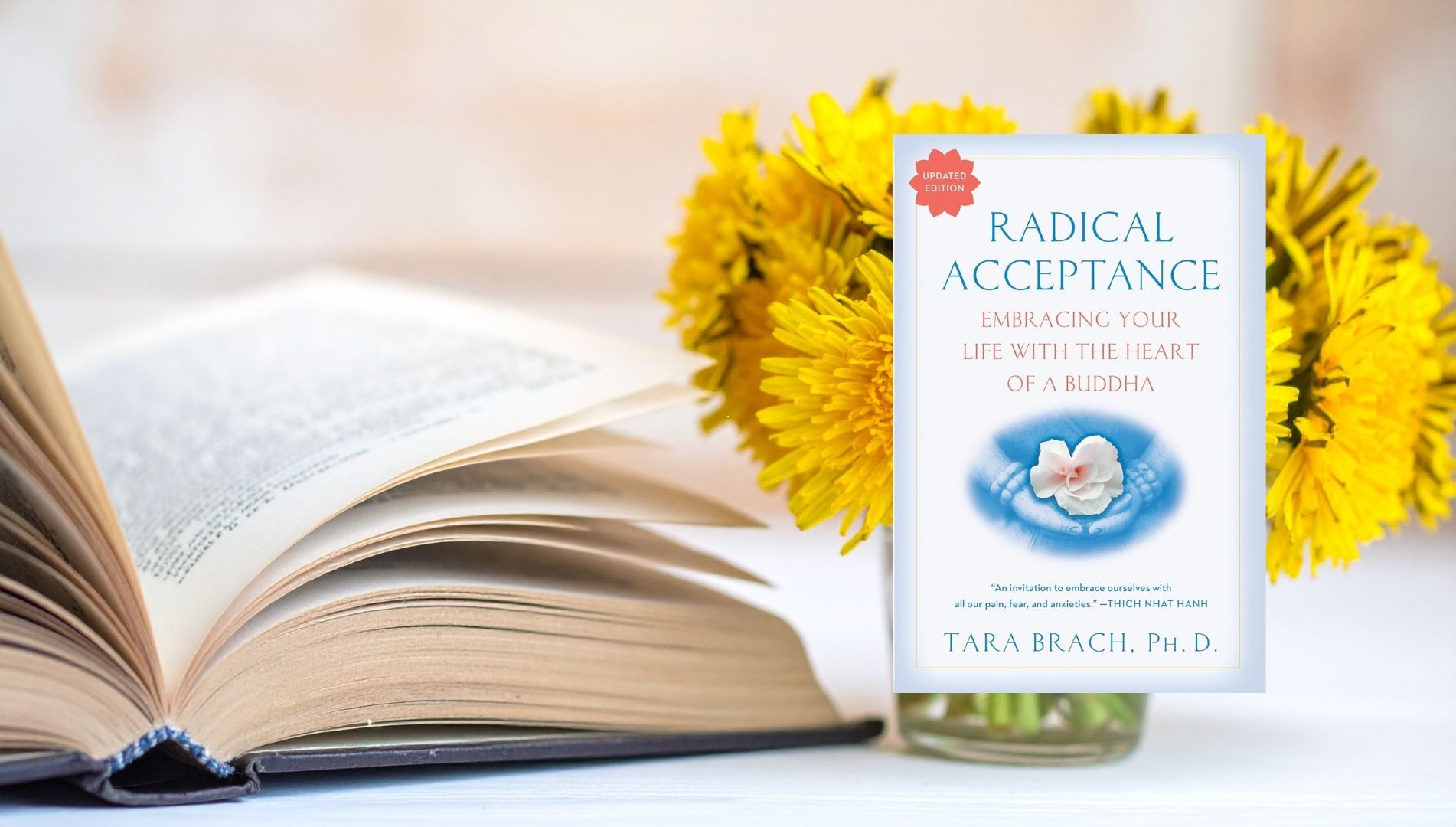
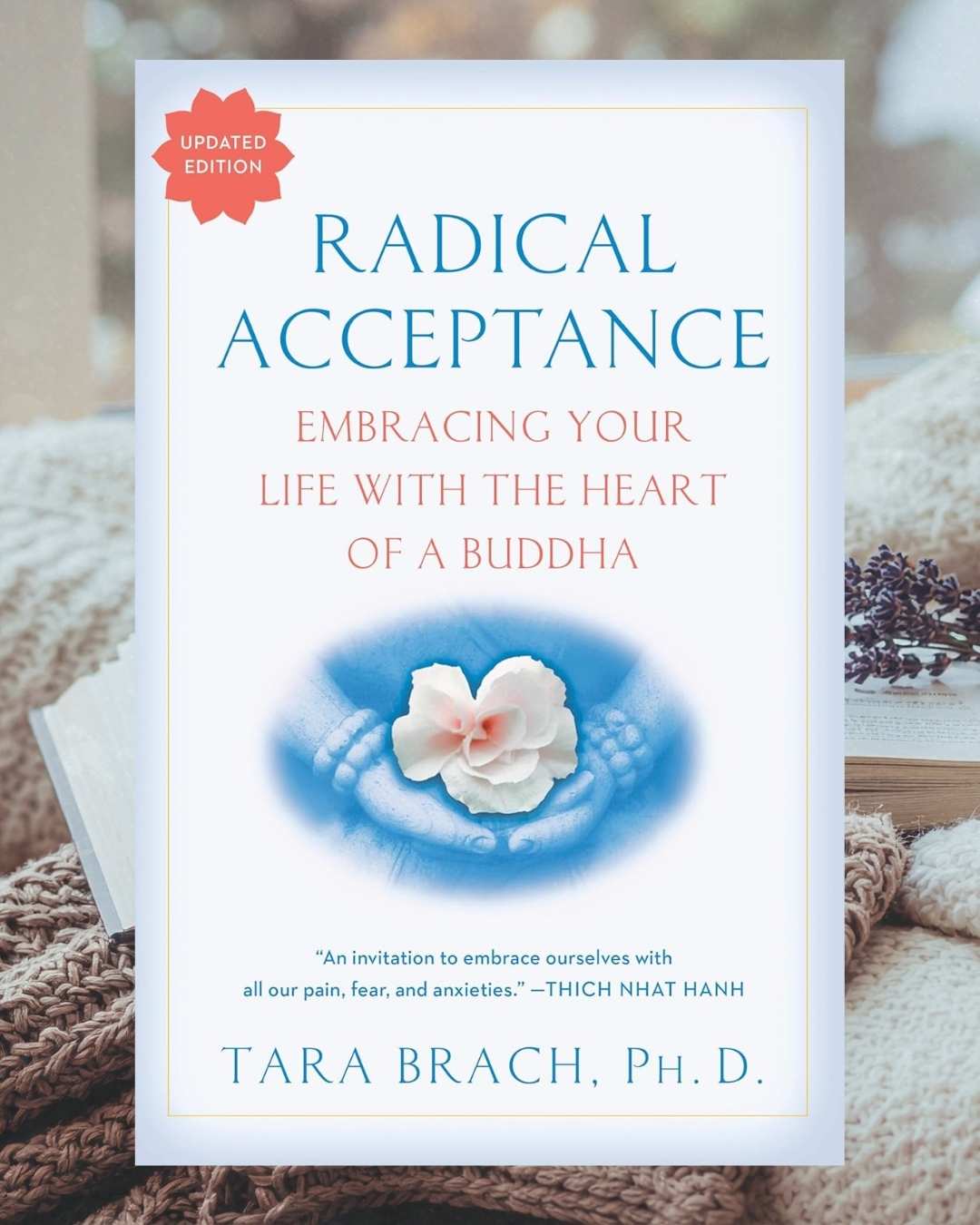
Welcome to Soften Sundays — your monthly reading companion for Radical Acceptance. Open the week you're in, sit with what resonates, and let the rest find you when it's ready. 🧡
- Introduction — Awakening from the Trance of Unworthiness
- Ch. 1 — The Trance of Unworthiness
- Ch. 2 — Awakening from the Trance: The Path of Radical Acceptance
- Ch. 3 — The Sacred Pause: Resting Under the Bodhi Tree
Brach opens with the story of the Golden Buddha — a magnificent statue hidden beneath layers of clay to protect it from invaders, its radiance forgotten over centuries. She offers this as a living metaphor: we too cover our innate wholeness with layers of shame, striving, and self-doubt. The book begins with one essential question: what would it mean to remember who we really are?
"Radical Acceptance is the willingness to experience ourselves and our life as it is."
The Golden Buddha story is a beautiful anchor for all of April. Consider opening class this week by inviting students to "soften one layer" — not a dramatic unravelling, but a quiet permission to arrive exactly as they are. A simple cue: "You don't need to fix anything to be here. You're already here."
Brach explores the deeply conditioned belief that we are fundamentally flawed — not good enough, not loving enough, simply not enough. Drawing on Buddhist psychology and her clinical experience, she maps how the trance operates through constant doing, striving, comparing, and numbing. This chapter names the trance gently but unflinchingly, and in naming it, begins to loosen its grip.
"The trance of unworthiness keeps us from the truth of who we are."
The trance of unworthiness lives in the body — the held breath, the braced shoulders, the belly sucked in. In class this week, try cueing a full exhale and an invitation to let the belly soften: "You don't have to hold anything in here." That single cue can be quietly radical for the people in the room.
For students who tend to push too hard in practice: "Your edge isn't where you prove yourself. It's where you're honest with yourself."
This chapter introduces the heart of the book: Radical Acceptance as both a practice and a path. Brach presents RAIN — Recognize, Allow, Investigate, Nurture — as a framework for moving through difficult emotions with presence rather than resistance. Radical Acceptance doesn't mean giving up; it means being honest about what is actually happening right now and meeting it with genuine care.
"Between stimulus and response there is a space. In that space is our power to choose our response."
RAIN is a beautiful tool to introduce organically — especially during poses that bring up resistance. During a long hold, guide students through it without naming it: "Notice what's here. See if you can let it be, without trying to fix it. Get curious about the sensation. And now — be kind to yourself for staying." That's RAIN in four sentences.
Brach draws on the story of the Buddha sitting beneath the Bodhi tree — refusing to move, refusing to run from Mara (the force of fear and craving) — and arriving instead at liberation through presence. From this she offers the practice of the sacred pause: a deliberate interruption of habitual reactivity. In the pause, there is choice. In the pause, there is freedom.
"The pause is not empty. It is the moment where awareness enters."
The sacred pause is one of the most practical gifts we can offer in class. Build it into April deliberately: a longer pause before the next pose, a breath of stillness before transitioning, a few seconds of silence after savasana before speaking. Teach the pause by practicing it yourself — visibly, slowly, without apology. Students learn from your tempo.
Next week we move into the heart of presence. Brach asks: what does it actually feel like to be fully here — in your body, in your experience, without agenda? Chapters 4, 5, and 6 explore unconditional presence, the wisdom of the body, and the surprising grace that lives within desire. Come ready to get embodied.
- Ch. 4 — Unconditional Presence: The Buddha's Smile
- Ch. 5 — Coming Home to Our Body: The Ground of Radical Acceptance
- Ch. 6 — Radical Acceptance of Desire: Awakening to the Source of Longing
Brach explores what it means to be fully present without preference for what we find — without needing this moment to be different. The Buddha's smile in classical depictions is not happiness in the conventional sense; it's equanimity: the capacity to be with joy and sorrow equally, without clinging to one or pushing away the other. This is the practice of unconditional presence — meeting life as it is.
"Presence is not some exotic state. It is our natural awareness, returned home."
This week, teach presence rather than performance. Begin class with a grounding moment that isn't goal-oriented: "We're not trying to get anywhere today. We're practising being here." Pay attention to your own equanimity as you teach — students feel it when you're ruffled, and they feel it when you're rooted. Your steadiness is a cue.
The body is not something we have — it's where we are. Brach explores how we habitually live above the neck, caught in thinking and planning, disconnected from the sensory intelligence of the body. Returning to body sensation is a direct and immediate path to presence. She also addresses how shame, trauma, and conditioning can make the body feel unsafe — and how gentleness is the way back.
"When we stop fleeing from our experience and turn toward it with kindness, we come home."
This is perhaps the most directly applicable chapter to our teaching. Consider opening class this week with a body-scanning arrival — not to fix or adjust, but simply to acknowledge: "Notice where you are in your body right now. Not where you think you should be. Where you actually are." Let that be the whole practice for a moment.
For students who habitually push through discomfort: "The bravest thing you can do in this practice is feel what's actually here — not what you think should be here."
Desire is not the problem — our relationship with desire is. Brach distinguishes between grasping (clinging to desire, or pushing it away in shame) and the natural energy of longing itself. When we bring Radical Acceptance to desire — really meet it — we discover what's underneath: a deeper ache for connection, belonging, and wholeness. Meeting desire with presence transforms it rather than amplifying it.
"Our longing is not a problem to be solved. It is a doorway."
In teaching, desire shows up in subtle ways — the need for students to respond, to return, to approve. This chapter is an honest invitation to examine what we seek from our work. Try this: when you notice the pull toward external validation this week, get curious about what's underneath it. No judgment. Just noticing. That's the practice.
Week 3 takes us into more tender territory — fear, self-compassion, and the expanding circles of care for all beings. Brach doesn't shy away from the hard places. These three chapters are some of the most emotionally rich in the book. Come with an open heart and give yourself permission to be moved.
- Ch. 7 — Opening Our Heart in the Face of Fear
- Ch. 8 — Awakening Compassion for Ourselves: Becoming Our Own Best Friend
- Ch. 9 — Widening the Circles of Compassion: The Bodhisattva's Path
Fear contracts. Brach examines how fear — even the subtle, background kind — closes us off from life, from others, from ourselves. Rather than overcoming fear, she teaches meeting it: staying with it in the body, allowing it to move through rather than being controlled by it. Fear, when met with awareness and compassion, loses much of its power to run the show.
"Fear is not the enemy. Locking fear out of your heart is the enemy."
Fear often lives in the chest and throat — the places we guard most carefully. In class this week, notice if students are holding their breath (a common fear response) and cue the exhale with care: "Let the breath soften the chest. You're allowed to feel whatever is here." Trust that your students are carrying something. They always are.
Self-compassion is not self-indulgence — it is the foundation of the entire path. Brach explores why we extend kindness so readily to others while remaining harsh with ourselves, and what it costs us over time. She introduces lovingkindness (metta) practice beginning with the self, and gently works with the deep resistance many people feel when first trying to offer themselves genuine care.
"You yourself, as much as anybody in the entire universe, deserve your love and affection."
We teach what we most need to learn. If self-compassion is still hard for you, your students sense that — they feel when there is permission in the room and when there isn't. This week, try holding yourself with the same care you extend to your students. Notice what shifts in how you carry yourself, how you speak, how you move through the studio.
For students who are hard on themselves in practice: "The practice isn't asking you to be perfect. It's asking you to be honest — and to be kind about what you find."
From self-compassion, the circles naturally expand. The Bodhisattva — in Buddhist tradition, the being who dedicates their awakening to the liberation of all — is not a superhero but a model of what compassion looks like when it stops being conditional. Brach explores how interconnection is the actual ground from which genuine compassion grows, and what it means to extend that warmth beyond those we already love easily.
"Compassion is not a relationship between the healer and the wounded. It is a relationship between equals."
This chapter asks us to see our students not as people we serve, but as people we're walking alongside. The shift is subtle but profound. Try beginning class this week with a silent internal metta for each student who arrives: May you be at ease. May you know your own goodness. No one needs to know you're doing it. Let it quietly change how you see the room.
The final week brings us home. Chapters 10 through 12 and the Epilogue circle back to where we began — but now we see it differently. Basic goodness. Relationships as practice. The path continuing forward. Come ready to complete the book and bring your reflections to the Zoom call.
- Ch. 10 — Recognizing Our Basic Goodness: The Gateway to a Loving Heart
- Ch. 11 — Awakening Together: Practicing Radical Acceptance in Relationships
- Ch. 12 — Continuing Our Awakening: The Path of Radical Acceptance
- Epilogue
The Golden Buddha returns. After a month of gently peeling back layers of unworthiness, grasping, fear, and conditioning, Brach leads us back to the central truth: our basic goodness is not something we build or earn — it's what we are underneath everything else. Recognizing goodness in ourselves and others is not naive or sentimental; it is a precise act of clear seeing, and the gateway to a genuinely open heart.
"Basic goodness is not something we earn. It is what we are."
One of the most powerful things we can do in class is reflect goodness back — not in a performative way, but by genuinely seeing people. Try this: at some point during class this week, let yourself be actually moved by the fact that these people showed up, on their mats, trying. Let that gratitude be quietly visible. It creates a field that everyone can feel.
Relationships are one of the most potent — and most challenging — arenas for Radical Acceptance. Brach explores how our deepest conditioning shows up most vividly with other people, and how the practice of seeing clearly, listening fully, and responding rather than reacting can transform not just how we relate but who we become in relationship. The teaching is simple. The practice is lifelong.
"The most precious gift we can offer anyone is our attention."
Our classes are relationships — with each student individually and with the group as a whole. Radical Acceptance in teaching means letting a class be what it needs to be, not what you planned. It means meeting the room. What would it feel like to truly arrive into this particular group, on this particular day, and let that be enough?
For students who find group classes uncomfortable: "Being in this room together is already the practice. You don't have to perform. You just have to be here."
Brach closes not with a conclusion but with a continuation. Radical Acceptance is not a destination — it's a lifelong returning: to presence, to kindness, to the truth of this moment. The Epilogue is a tender letter of encouragement for the road ahead, reminding us that every sacred pause, every breath of genuine awareness, every act of self-compassion, however small, is the path itself.
"This moment always will have been."
This month asked something of all of us — not effort exactly, but willingness. Willingness to look, to feel, to soften. As you close out April in your classes, consider this simple offering: "Whatever you've been carrying this month — you're allowed to set it down. Even just for this hour." That's Radical Acceptance in one cue.
🌿 You finished the book. That's no small thing.
A month of softening. Of pausing before reacting, returning to the body, meeting fear with curiosity, and practising compassion — first for yourself, then for the people around you. Bring your reflections, your questions, and your honest experience to the Zoom call. We can't wait to hear what moved you.
Let's Talk It Out
Two sessions at the end of April — attend one or both. Bring your book, your notes, and your honest reflections. All are welcome exactly as they are.